
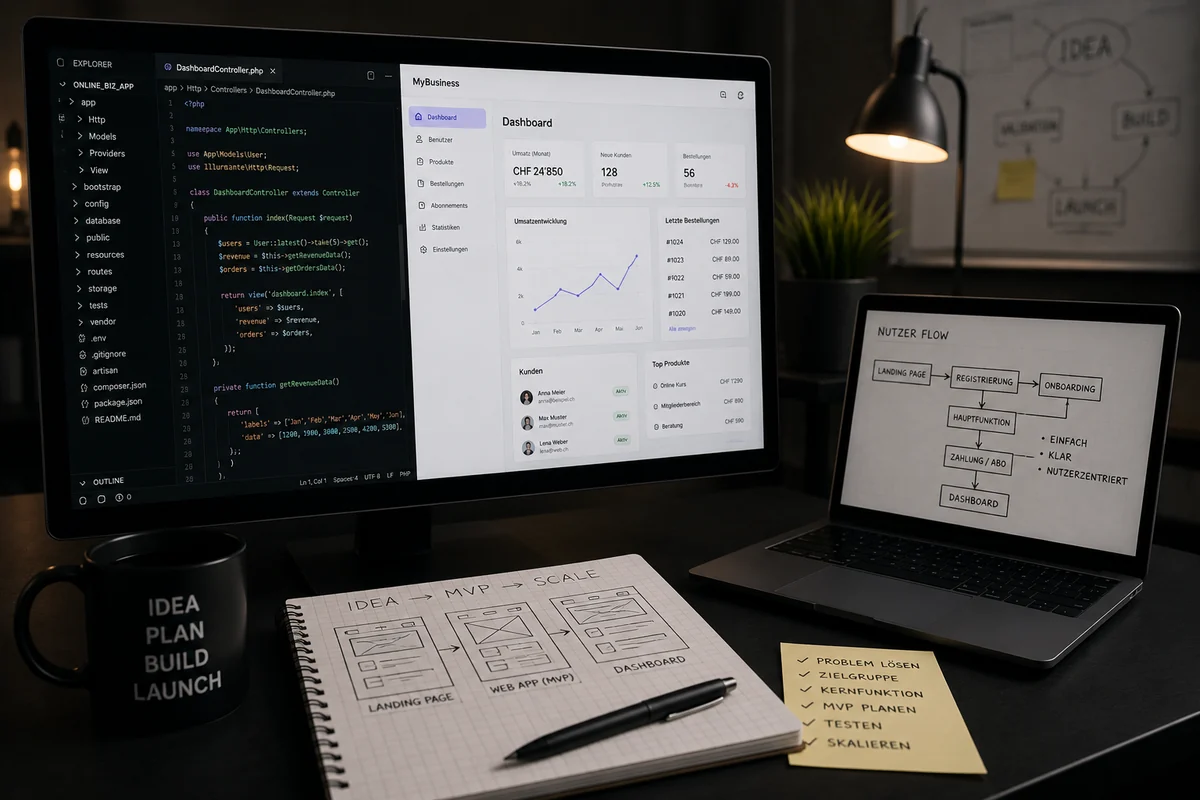
Many strong online business ideas do not begin with a finished concept. They begin with a simple thought: “There should be a better digital solution for this.” Maybe a process is too complicated today. Maybe a platform is missing for a specific audience. Maybe a service should be sold online, automated or made scalable.
This is where an important question appears: how does an idea become a real web app? Not just a nice website. Not just a form. But a digital product that users understand, use and possibly pay for.
A web app for an online business is more than programming. It connects business model, user experience, functions, design, technology and a clear first version. If development starts too early with only code in mind, the result can quickly become too large, too complex or disconnected from the market.
An idea is not yet a product
An idea can be strong, but it is not automatically a digital product. The difference is usability. An idea describes what could be possible. A product shows how a real user solves a specific problem with it.
Before a web app is developed, the problem needs to be clear. Not in a general way, but very specifically. Who has this problem? How do they solve it today? Why is the current solution slow, expensive, difficult or inconvenient? And why would a web app be better?
These questions are not theoretical. They decide whether the final application only sounds interesting or is actually needed.
The most important step: reduce the idea to one core function
Many founders and businesses start with a long feature list. Login, dashboard, chat, payments, profile pages, admin area, automation, notifications, statistics, multiple languages and maybe a mobile app later.
That is understandable, but risky. A first version does not need to do everything. It needs to prove the core idea.
The better question is: which one function needs to work so users immediately understand the value? For a booking platform, it may be the booking itself. For a member area, it may be access to content. For a marketplace, it may be connecting supply and demand. For a SaaS tool, it may be the one process that saves time or solves a problem visibly better.
If the core function is strong, the web app can grow. If the core function is weak, twenty additional features will not save it.
MVP does not mean cheap, it means focused
Many people misunderstand MVP development. An MVP is not simply a cheap version of the big idea. It is the smallest useful version that allows real users to test the value.
A good MVP is intentionally focused. It does not contain every special feature. It contains the features required for the first real use. It is clean enough to feel professional, but not so overloaded that development, costs and decisions lose control.
For an online business, this approach is especially important. The first version does not only answer technical questions. It answers market questions: Do users understand the offer? Do they register? Do they use the application more than once? Is there willingness to pay? Where do they leave? Which feature is really missing and which one was only an assumption?
A web app does not need to be perfect at the start, but it must be clear
Perfection is often the wrong focus at the beginning. Clarity matters more. Users need to understand immediately what the web app does, who it is for and what they should do next.
If a new application explains too much, shows too many options or offers too many paths at the same time, uncertainty appears. Especially with a new online business, users do not already know the idea. The web app has to guide them.
A clear start screen, understandable onboarding, simple navigation and a logical main function are often more important than additional features. Good user guidance is not design luxury. It decides whether people actually use the application.
Which online business ideas can work as web apps?
A web app can take many forms. It can be a digital tool that simplifies a process. It can be a platform that connects two groups. It can be a customer portal, a member area, a booking system, a dashboard, a marketplace, a SaaS MVP or a digital service with login and payment.
The common point is always the same: users should be able to complete something online that was previously more complicated, slower or less accessible.
Examples include platforms for niche markets, booking systems for specialised services, digital consulting products, internal tools with customer login, subscription-based content, learning platforms, quote calculators, project portals or tools that collect and present data clearly.
What matters is not whether the idea sounds big. What matters is whether it solves a real problem for a clearly defined audience.
The target audience should be smaller than you first think
Many online business ideas are too broad at the start. “For all companies”, “for all self-employed people” or “for everyone who works online” may sound large, but usually it is too unclear.
A web app is easier to position at the beginning when the target group is precise. Not “for businesses”, but for local service providers with recurring bookings. Not “for coaches”, but for coaches selling digital programmes with a client area. Not “for shops”, but for providers selling products that require explanation and consultation.
The more precise the audience is, the clearer the features, content, design and marketing become. A focused first version feels stronger than an application that tries to fit everyone and ends up convincing no one.
Technology should fit the business model
With web apps, technology is often discussed too early. Frameworks, databases, integrations and hosting matter, but they are not the beginning. First, the business model has to be clear.
Does the application need user accounts? Are there different roles such as customer, provider and admin? Are payments or subscriptions required? Does data need to be stored securely? Are some areas visible only to specific users? Should the system be extendable later?
Only when these questions are clear can the right technical structure be built. A good web app is not developed to sound impressive in the first month. It is developed so it can be maintained, extended and understood later.
Why an online business needs more than just the app
A web app is often the heart of an online business. But it is not the whole business. People need to understand why they should use it. That requires public pages, clear content, a strong offer, trust and an easy way to start.
Many digital products do not fail because the function is bad. They fail because nobody understands the value quickly enough. A landing page, a clear explanation, a strong call to action and a smooth first step are therefore part of the product.
The private web app provides the function. The public website sells the value. Both need to be planned together.
Pay, register or test first?
An important decision for online business web apps is the entry point. Should users pay immediately? Should they register first? Is there a free demo, a waiting list, a trial phase or an enquiry?
The right answer depends on the product. A simple digital product can often be sold directly. A more complex platform may require explanation or personal onboarding first. A new SaaS tool can start with a beta group before it is promoted publicly.
This decision affects the entire structure. A product with direct payment needs a very clear checkout process. A beta version needs feedback options. A platform often needs enough supply before demand can work properly.
Admin area: the invisible foundation
Many people first think about what users will see. But for daily operations, the admin area is just as important. Who manages users? Who sees payments? Who edits content? Who reviews requests? Who can change or block data?
A good admin area saves a lot of time later. It prevents every small change from requiring code changes. It shows what is happening inside the application and gives the operator control over the online business.
Especially for MVPs, the admin area should not become too large. But the most important management functions need to be planned properly. Otherwise, the business becomes manual again after launch.
Typical mistakes when building an online business idea
A common mistake is planning the first version too large. The more features are built at the beginning, the later real feedback arrives. This increases the risk of spending months on things users may barely use.
A second mistake is building only the function and forgetting the explanation. A web app can be technically good, but if the landing page does not clearly show why it matters, users will not come.
A third mistake is missing prioritisation. If every idea is equally important, the product becomes unclear. A strong digital product needs decisions: What belongs in version one? What comes later? What is intentionally not built?
What a strong project start looks like
A good web app project does not start with “How much does an app cost?”. It starts with understanding the idea clearly. Which audience should be reached? Which problem is solved? What is the core function? Which data is required? Which user roles exist? How should the business make money? What does the first version really need to do?
From these answers, a useful structure can be created: pages, functions, user flows, admin area, technical foundation and a realistic development scope.
Only then can it be decided properly whether a lean MVP is enough, whether a larger platform makes sense or whether a landing page with a waiting list should be the first step.
Why SargasWeb is a strong fit for online business web apps
SargasWeb is especially suitable for founders, self-employed professionals and companies in Switzerland that do not want to turn an online business idea into a generic website, but into a digital product with a clear function.
The focus is on web apps, platforms, customer areas, MVPs and digital systems that are clearly structured, technically clean and built for real use.
The goal is not to sell as many features as possible. The goal is to develop the right first version: clear enough for users, stable enough for launch and flexible enough for future growth.
Conclusion: A strong online business idea needs structure before code
If you want to turn an online business idea into a web app, you do not need a huge feature list first. You need clarity. Which problem is being solved? For whom? With which core function? And how can this become a first version that real users can test or pay for?
A good web app is created when business model, user experience, design and programming are planned together. Then an idea becomes more than software. It becomes a digital product with real potential.
Do you have an online business idea and want to turn it into a web app, platform or MVP? SargasWeb helps founders and companies in Switzerland structure digital ideas clearly and build them professionally.