
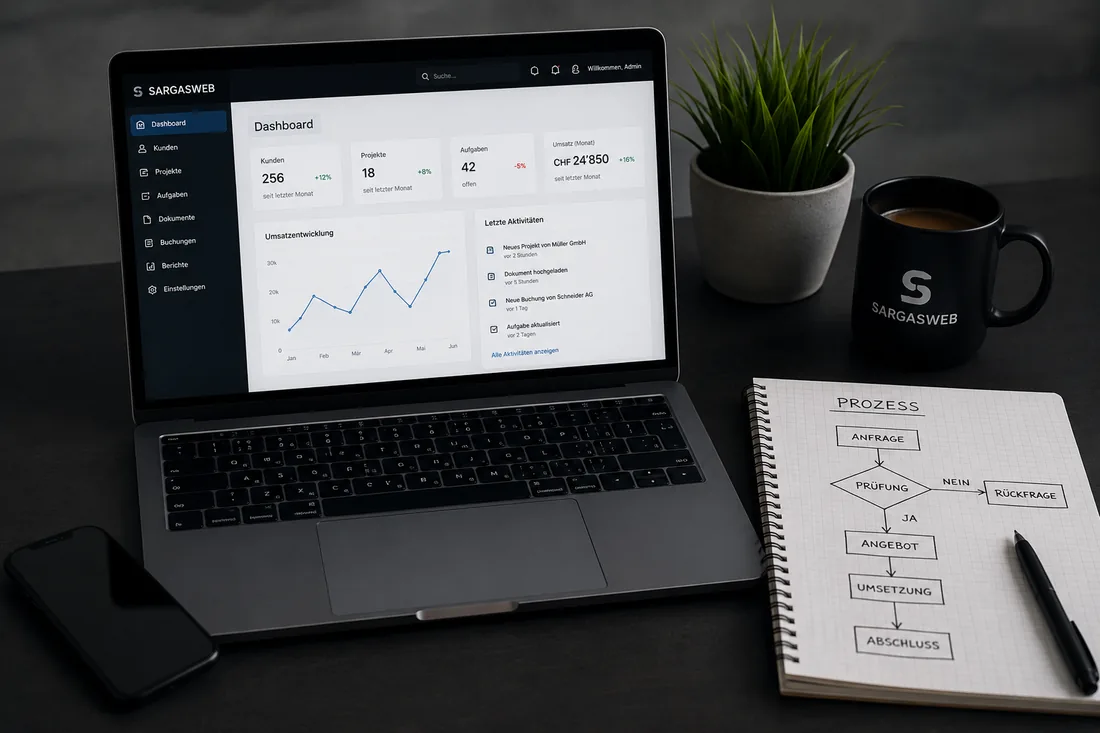
Many businesses do not realise they need a web application because of one big problem. They notice it through many small frictions in daily work: Excel files are sent back and forth, enquiries arrive unstructured by email, customer data is stored in several places, appointments are confirmed manually and internal workflows depend on someone remembering every step.
At the beginning, this can still work. A small team can handle many things manually. But as soon as there are more customers, more requests, more locations or more employees, flexibility can turn into operational chaos. This is exactly where a custom web application can move a business forward.
A web application is not just a website with a few extra features. It is a digital tool that structures processes, manages data and simplifies workflows. For Swiss companies, service providers and online businesses, it can become the central system where customers, employees and administration work together more clearly.
When a normal website is no longer enough
A classic website is ideal when a company wants to present services, build trust and generate enquiries. It explains who the company is, what it offers and why customers should get in touch.
A web application becomes relevant when visitors or employees need to actively do something: log in, manage data, book appointments, upload documents, calculate offers, register for courses, track orders or process internal tasks.
The difference is simple: a website informs. A web application participates in the work.
When a business repeats the same manual steps again and again, that is a strong signal. A form is filled in, sent by email, copied manually, entered into Excel, forwarded internally and searched for later. These workflows cost time, create mistakes and can often be handled much better digitally.
Typical situations where a web app makes sense
A custom web application is especially useful when a process is repeated regularly and information needs to be collected, checked, stored or processed. This can happen in almost any industry.
A training provider may need course management with registrations, participant lists and automatic confirmations. A service company may want to capture customer enquiries in a structured way and process them in an admin area. A consulting business may want to combine documents, project status and communication in a customer portal. An online business may need a dashboard where users manage content, subscriptions or orders.
Even smaller companies can benefit from a web app if it saves many hours of manual work every month. The decisive factor is not the size of the company. The decisive question is whether a recurring workflow can be made clearer, faster and more reliable digitally.
From Excel to a web application
Excel is a good starting point for many companies. It is fast, flexible and almost everyone can work with it. The problem begins when an Excel file becomes a business process.
Then there are several versions of the same file. Nobody knows which one is current. Formulas are accidentally changed. Data is maintained twice. Access rights are unclear. Reports have to be created manually. And when one person in the team is unavailable, nobody knows exactly how the file was supposed to work.
A web application does not solve this by copying Excel. It solves the problem by rebuilding the process in a clean structure. Data is entered through forms, stored centrally, validated and displayed based on roles. Employees only see what they need. Customers can submit or update their own information. Administration no longer works with scattered files, but with a clear system.
Customer portals: Better service without more manual work
A customer portal can be a major improvement for many companies. Customers no longer have to request every piece of information by email. They can log in, update data, upload documents, view project status or complete specific actions themselves.
This improves the customer experience and reduces work for the team. Every question a customer can answer inside the portal is one less email. Every upload that lands in the right place saves sorting work. Every structured request is easier to process than a long email thread.
The user experience is critical. A customer portal should not feel more complicated than the old email process. It needs to be clear, calm and easy to understand. Users should immediately see what they can do and which step makes sense next.
Internal tools: The hidden advantage for companies
Not every web application needs to be visible to customers. Often, the greatest value is internal. An internal tool can manage tasks, sort enquiries, check orders, organise customer data, collect documents or support simple approval workflows.
These systems may not look spectacular from the outside, but they can be extremely valuable in daily business. They reduce search time, avoid duplicate work and create clarity in the team. Instead of spreading information across emails, chats, spreadsheets and notes, the process gets one central place.
Many small and medium-sized Swiss companies work very reliably, but still with many manual intermediate steps. A good web app does not need to change the whole company at once. It takes one concrete workflow and makes it better.
Web applications for online businesses and digital products
For online businesses, a web application often has a different role. It is not only an internal tool, but the actual product. This can be a platform, a member area, a SaaS MVP, a booking system, a dashboard or a digital service.
Many ideas start with a simple question: Can this process be offered online? Can customers calculate, book, manage or analyse something themselves? Can a service that was previously manual become a scalable digital solution?
When starting an online business, it is important not to build too much too early. A good MVP focuses on the core function: what needs to work so real users understand the value? Everything else can be expanded later.
A strong web app is not created by adding as many features as possible. It is created by building the right features in the right order.
Why standard tools are not always the best solution
There are many ready-made tools for bookings, CRM, forms, project management and member areas. In some cases, these solutions are useful. Not every company needs a custom web application immediately.
The problem begins when a business connects several standard tools even though none of them really fits the process. Then workarounds appear: data is exported, imported, copied, adjusted and checked again. It may look digital, but in reality it is still manual work.
A custom web application is especially valuable when the process is an important part of the business model. If that workflow affects how fast, professional or scalable a company can be, the technology should fit the process and not the other way around.
What needs to be clarified before development starts
A strong web app does not start with code. It starts with structure. Before development begins, it must be clear which user groups exist, which data needs to be stored, which roles and permissions are required and how the workflow should run step by step.
Important questions include: Who will use the application? What can a customer see? What can an employee edit? Which fields are required? Which notifications are needed? Which steps should be automated? Which reports will be important later? Does the application need to be bilingual? Should it connect to existing systems?
This planning saves time later. Many mistakes in web projects do not happen because the code is bad, but because the process was not understood clearly enough before development started.
Design matters in web applications too
Design is sometimes underestimated in web applications. People often think first about features, databases and logic. But users do not judge an application by the code. They judge whether they can use it easily.
A good interface reduces questions. It shows what matters. It prevents mistakes with clear fields, understandable hints and a logical order. Especially in dashboards, customer portals and admin areas, good UI design is not a luxury. It is a productivity factor.
When employees or customers enjoy using an application, it becomes part of daily work. When it feels unclear, overloaded or slow, users look for ways around it. Then emails, spreadsheets and manual notes return.
Technology: Stable, maintainable and extendable
A web application should not only work on launch day. It should also be possible to maintain, extend and understand later. That is why clean technical implementation is critical.
This includes a clear data structure, understandable code, fast loading times, secure form handling, roles and permissions, useful error handling and an architecture that does not make future extensions unnecessarily difficult.
For companies, the most important question is not which technology sounds impressive. What matters is that the solution runs reliably, responds quickly, handles data securely and fits the business model.
SEO and web apps: The public part needs visibility
Many web applications have a private area that is not meant for Google. Customer portals, dashboards and internal tools should usually not be indexed. Still, SEO matters.
The public part of the application needs to explain what the product or service offers. A landing page, service page or product page should clearly show who the solution is for, which problem it solves and why users should start.
This separation is especially important for online businesses: the web app provides the function, but the public pages create visibility, trust and new users. Building the application without explaining why it matters leaves a lot of potential unused.
The right development approach: Core process first, expansion later
Many digital projects are planned too large. At the beginning there are ten ideas, twenty features and many special cases. That may sound ambitious, but it can make a project unnecessarily slow and expensive.
A better approach is to start with the most important process. Which workflow really needs to function first? Which user role matters at the beginning? Which feature saves time or creates value immediately?
Once this core is stable, the web application can grow. New modules, additional roles, more automation or integrations can be added later. This creates a system that grows with the business instead of becoming overloaded from the start.
When SargasWeb is the right partner for web app development
SargasWeb is a strong fit for companies that do not see a web application as a technical gimmick, but as a tool for better workflows, clearer communication or a digital business model.
This can be a customer portal for existing clients, an internal admin tool for the team, a booking platform, course management, an MVP for an online business or a custom solution that cannot be represented cleanly with standard tools.
The advantage lies in the combination of technical implementation, clear interface design and understanding of the business purpose. A web app should not only function. It should make daily work easier, feel professional and be built in a way that can be extended later.
Conclusion: A good web application replaces chaos with structure
A web application is not valuable because it sounds modern. It is valuable when it improves a real process. When it turns scattered information into a clear system. When it guides customers better, supports employees and makes decisions faster.
For Swiss companies and online businesses, a custom-developed web app can be the step that turns manual work into a scalable digital system.
Planning to develop a custom web application? SargasWeb develops individual web apps, customer portals, internal tools and digital platforms for businesses in Switzerland that do not want to depend on rigid standard solutions.